



Best ‘Pirates of the Caribbean’ ride Easter eggs in the movies
Inspired by a beloved theme park attraction with decades of history, the “Pirates of the Caribbean” movies are a trove of Easter eggs and hidden references to the classic Disney Parks boat ride.

20 Years of Pirates
The first film in the series, 2003’s “Pirates of the Caribbean: The Curse of the Black Pearl,” turns 20 years old this week. To celebrate the anniversary, the movie returns to theaters for a limited-time, two-week engagement starting July 7, 2023. (The official anniversary is July 9.) The reissue is one of eight Disney hits returning to the big screen soon as part of Disney100.
If you really want to feel old, consider this: more time has passed between the first “Pirates” and today than the time between “Back to the Future” and the first “Pirates.”
The anniversary is especially timely as Disney preps for “Haunted Mansion,” the re-imagined film version of another classic Disney attraction, which hits theaters July 28, 2023.
So just where in the “Pirates of the Caribbean” movies should you keep a sharp eye out for Easter eggs? Or should I say… buried treasure? (Sorry).
Dog with the Keys
You know him. You love him. He’s the icon of the ride (he walked so Chuuby could run.) He is, of course, the dog with the keys. The lovable pup shows up repeatedly in the first three “Pirates of the Caribbean” films.

In “The Curse of the Black Pearl,” the adorable mutt holds the keys to the Port Royal jail cell in his mouth. The imprisoned pirates try to lure him over to set them free. In doing so, they recreate the classic gag from the end of the ride.

At first, Captain Jack Sparrow (Johnny Depp) scoffs at his cellmates. It’s not long, though, before he tries out the technique himself.

In the 2006 follow-up, “Pirates of the Caribbean: Dead Man’s Chest,” the same pup is inexplicably on a raft boat in the middle of the ocean with Pintel (Lee Arenberg) and Ragetti (Mackenzie Crook), former members of the Black Pearl’s cursed crew. Again, the doggie proudly carries his keys. Upon arrival on land, a group of islanders perceive the dog to be a god.

Without explanation, the dog comically returns yet again for round three, 2007’s “Pirates of the Caribbean: At World’s End.” He regally handles the keys to “the code,” a hallowed tome of pirate rules (or guidelines, depending on who you ask). The dog delivers the keys to Captain Teague (Keith Richards) during the Brethren Court’s meeting.

What a good boy.

Yo Ho, Yo Ho, A Pirate’s Life For Me
Imagineer Xavier “X” Atencio, who was not a songwriter, famously wrote the ride’s theme song, “Yo Ho (A Pirate’s Life For Me),” simply because Walt Disney thought he was the man for the job. From that point on, X was a songwriter and went on to co-write “Grim Grinning Ghosts” for Haunted Mansion.
X’s lyrics from the ride, and occasionally even his non-lyrical dialogue, pop up throughout the “Pirates of the Caribbean” movies. The first and third movies conclude with Captain Jack uttering the lyrics “Drink up, me hearties, yo ho” before composer Klaus Badelt swells Jack’s instrumental theme and the credits roll. Also in the first film, Jack and Elizabeth Swann (Keira Knightley) sing the shanty together while stranded on a beach. (X got to visit the set at some point during the series’ filming and posed with Johnny Depp in full Captain Jack regalia. The Imagineer passed away in 2017.)

Anecdotally — but criminal to omit — in 2006, Jonas Brothers recorded a cover of the song for the album “Disneymania 4,” a compilation of Radio Disney stars singing favorite tunes from the studio’s filmography. However, since none of the Jonases were old enough to drink alcohol, the lyrics changed. Instead of singing “Drink up, me hearties, yo ho,” the brothers belted out “Stand up, me hearties, yo ho.” Not only is this absurdly glorious factoid absolutely true, but Disney’s Hollywood Studios still blasts the cover to this day while guests wait for “Fantasmic!” to begin. Never change, Hollywood Hills Amphitheater.
Tortuga
The town of Tortuga looks instantly familiar to anyone who’s taken a ride aboard the swashbuckling Audio-Animatronics spectacle. In Tortuga, pirates run rampant, and any rule that can be broken will be broken. Director Gore Verbinski captures the overall feel of the ride’s ransacked town quintessentially. Simultaneously, Verbinski references specific moments from the ride throughout the films’ Tortuga sequences.
One of our first impressions of Tortuga in “The Curse of the Black Pearl” is a man practically drowning himself in mugs of beer. One cup in each hand, he douses himself with an almost robotic-like movement. It’s not hard to imagine Verbinski might have instructed the actor to emulate the Audio-Animatronics figure that performs the exact same motions in the ride.

Also in the first film, Captain Jack finds Joshamee Gibbs (Kevin R. McNally) passed out with some pigs, a visual directly upended from the ride.

Later, in “Dead Man’s Chest,” Verbinski pans the camera to show us a lot of lawless behavior happening at once. Among the chaos are a few pirates dunking what appears to be a dignitary into a well. As the pirates raise him back up, the man cartoonishly spits water in a projectile motion, another gag made famous by the ride. The pirates then, of course, dunk him right back into the well.

Giselle and Scarlett
In all three of Captain Jack’s visits to Tortuga across the original trilogy, he encounters Giselle (Vanessa Branch) and Scarlett (Laura Maher). The two women have a mysterious, bitter past with ole Jack. We aren’t privy to the details, but their interactions always conclude with the ladies slapping Captain Jack across the face.

Giselle and Scarlett resemble a number of the women seen throughout the fire-raging town in the ride. Scarlett in particular brings to mind the character today known as Redd. Now a pirate, she leads an auction of rum and goods onboard the Disney attraction.
Dead Men Tell No Tales
The fifth (and, for now, most recent) volume in the series is 2017’s “Pirates of the Caribbean: Dead Men Tell No Tales.” The movie earns its namesake from an archaic phrase X Atencio worked into his script for the original Disneyland ride. As riders begin their journey, a talking skull (and an ominous, echoing voice) warns, “Dead men tell no tales.”

In fact, viewers can hear that exact audio clip verbatim in “At World’s End.” As Captain Jack’s crew journeys to save him from Davy Jones’ locker, their ship pummels over the edge of a waterfall. After the ship disappears from view, the screen fades to black and remains dark as audio clips from the Disneyland ride ebb and flow in and out of each other. Our antiheroes have crossed over into the ends of the earth, a place that seems to carry ethereal memories of pirate lore.

The audience can distinctly make out sound bites from the ride spoken by renowned voice actor Paul Frees. An instrumental refrain of “Yo Ho (A Pirate’s Life For Me)” is thrown into the mix, too. The moment ends with that same echoing voice from the ride foreboding “Dead men tell no tales,” and the film returns to its regularly scheduled programming. The brief moment is perhaps the most euphoric reference to the ride in the entire movie series.
Barbossa’s Pirate-Savvy Vocabulary
Captain Barbossa (Geoffrey Rush) has a habit of speaking in a slightly more sophisticated vernacular than his peers. He often declares sentences that sound distinctly, for lack of a better word, “piratey.”
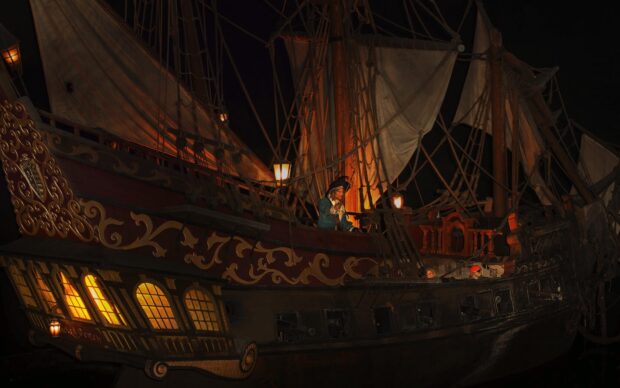
On a number of occasions, he repeats dialogue word for word of the Audio-Animatronics pirate captain who formerly greeted Disney guests just after their plunge into the pirates’ world. (“Strike your colors, ya bloomin’ cockroaches!”) It’s appropriate, then, that Barbossa replaced that very captain when Imagineers added his likeness to the ride in 2006.
Skeleton in Bed with a Magnifying Glass
The Disneyland (but not Walt Disney World) version of the ride features a skeleton in bed holding a magnifying glass. The poor soul seems to have passed away still searching for treasure.

In 2011’s “Pirates of the Caribbean: On Stranger Tides,” Captain Jack and Barossa come face to face (or, face to skull, I suppose) with this unlucky adventurer. They soon discover the skeleton belongs to explorer Ponce de Leon. The parchment under the magnifying glass’s gaze is a map leading to the Fountain of Youth.
Tia Dalma’s Shack
Another Disneyland-specific reference (sorry, Florida) is the unmistakable art direction of the home belonging to Tia Dalma (Naomie Harris) in “Dead Man’s Chest.” The enchantress lives in a shack in the middle of a swamp, surrounding by a thick carpet of fog.

Disneyland visitors may recognize this as nearly identical to the opening sequence of the ride’s west-coast iteration. Even though the ride distinctly begins in New Orleans and features a present-day man sitting on the shack’s porch (whereas Tia Dalma’s residence isn’t in New Orleans, that we know of), the visual is a pleasant callback all the same.
Skeleton at the Wheel
During early promotion for “The Curse of the Black Pearl,” Disney wanted to emphasize filmmakers’ respected for the classic ride, which was a wise forethought with audiences so recently scarred by 2002’s dud “The Country Bears,” the critical and box-office bomb derived from Walt Disney World’s Country Bear Jamboree.

Disney needed to communicate “Pirates” would be different. The initial teaser poster for the first “Pirates” adventure depicts a skeleton at the wheel of a ship. The figure determinedly carrying on as a storm rages. This same scene appears in the grotto section of the ride (on both coasts). As an indication of just how early Disney debuted this poster, note the lack of any subtitle. The poster simply calls the film “Pirates of the Caribbean,” without any “The Curse of the Black Pearl” in sight.

Great article.