



Attractions Expert Q&A: Tom Morris
As a creative development executive at Walt Disney Imagineering, Tom Morris was responsible for the conceptualization of Rock ’n’ Roller Coaster Starring Aerosmith at Walt Disney World Resort and conceptual direction for Cars Land at the Disneyland Resort.

By Kendall Wolf
Tom Morris grew up in Newport Beach, Calif., and worked weekends and summers at Disneyland, operating rides such as Autopia and the Submarine Voyage. Later, he worked as an apprentice draftsman at WED Enterprises (now Walt Disney Imagineering) and remained at Imagineering for 36 years, working on the design of Fantasyland and Sleeping Beauty Castle at Disneyland Paris Resort and overall creative oversight for Hong Kong Disneyland Resort, among other projects.
What theme park souvenir might we be surprised to find on your shelf, and what’s its story?

My most noteworthy one is something that was never sold in the parks: an “Atom Mobile” from Adventure Through Inner Space, one of the little vehicles you saw going up the microscope in the pre-show area.
Adventure Through Inner Space was a Tomorrowland attraction that opened in 1967 and it “shrunk you down to the size of an atom.” While you were waiting in line, there was a giant microscope above you, and you could see miniature versions of the same cars you were about to ride with tiny people inside them. The Atom Mobiles were designed to convince you that they were actually shrinking people. They’re highly sought after because there were only between 100 and 200 made.
What theme park have you always wanted to visit but have never been to?
The theme parks back east – Kings Island, Cedar Point, and Busch Gardens Williamsburg. They’re so famous and are supposed to be classic parks, well landscaped, operated, and maintained – and with some very good thrill rides.
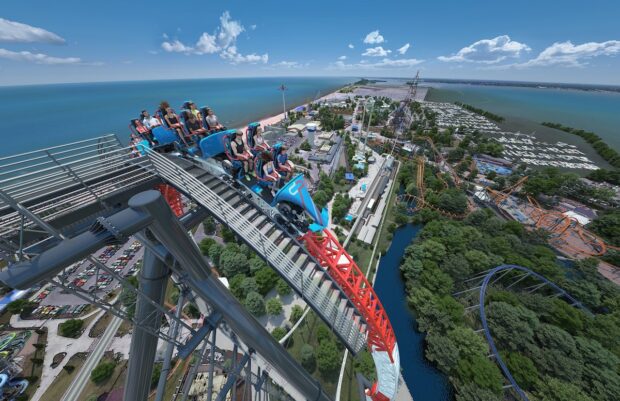
Concept art courtesy of Cedar Point
Was there a theme park or attraction that made you want to be in this industry, and how did it inspire you?

That’s easy. It was Pirates of the Caribbean. I visited the first year it opened in 1967. My dad happened to be a ride operator because he was a high school teacher, and teachers often worked at Disneyland in the summer.
My dad taught Theater Stagecraft in high school and would design and build the sets, so he knew a little about theatrical trickery and told me about some of the illusions and effects that were part of that ride. It really intrigued me, and I thought, “There’s something I could do when I grow up.” I initially wanted to be an animator and an architect, but at some point, I thought, “Wow – I would really like to work on rides at Disneyland.”
Part of me thought, what are the chances of that? But as I got into high school, I realized no one knew about WED Enterprises (Walter E. Disney Enterprises), which was the original name of Imagineering, so maybe there isn’t a lot of competition to get in there (certainly not like it is now). I took three years of drafting in high school (and many film and communication classes) and ended up at Imagineering as an apprentice set design draftsman (where I stayed for the next 36 years).
What was your favorite ride or attraction as a child, and why?
The first one (when I was just a toddler) was Snow White’s Adventures. According to one of my sisters, I was scared and screaming, but couldn’t wait to get back on. For a few years after that, it was Tom Sawyer’s Island, but when Disneyland added It’s a Small World, I loved it because it was so unique. That didn’t last because the following year, they opened Pirates, and that became my favorite attraction.

However, since I was four or five years old, I was intrigued by the Haunted Mansion because it wasn’t open. It remained there for over six years – empty – but other projects got in the way of being able to work on it, such as New Orleans Square and Small World. Every time we’d go to Disneyland, I’d run over to The Haunted Mansion to see if it had opened, and when it finally did, that was my favorite attraction for a long time.
I don’t know if I have a favorite attraction now, but I’m still most intrigued by the Disneyland version of Pirates of the Caribbean because there’s a certain mastery of time and space. Time slows down, and space expands in an area that isn’t that big. It’s a 15-minute attraction, but it can seem much longer.
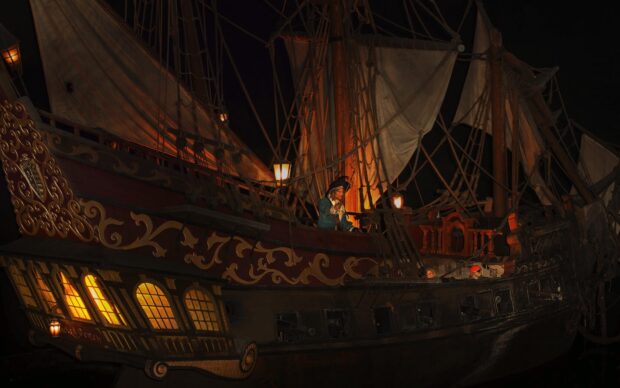
They pulled out all the stops and used all the tricks they learned up until then on that attraction. My admiration for Pirates of the Caribbean has only gotten stronger because there are many shortcuts they took, but you don’t see them. There’s a lot of scenic work that your brain thinks is fully dimensional, but it may actually be flatter than you realize. Plus, the ride winds around so you get geographically lost, and that’s part of what takes you back in time and to another place. It’s very intriguing for me, so whenever I did a ride layout, I always kept the importance of track layout in mind as an essential part of attraction development.
In many ways, the ride layout is analog to what a cinematographer and an editor do for a live-action film. It determines what you see, when you see it, and how you see it. And how one scene segues into another. You can reveal things at the last minute or conceal things as well. The ride layout is the secret ingredient.
Was there a ride, attraction, or character that frightened you as a child?
The Rocket Jets at Disneyland, which were on the third floor. The base where you loaded was 35 to 40 feet above the ground. I remember being a little bit frightened just taking the elevator and realizing we were going to be up really high. Also, at the time, there were no seat belts—the centrifugal force kept you in. So I was a little scared the first time I rode that—it was up so high, and those rockets flew at such a steep angle.
What’s your oddest or coolest job in a theme park?
The Disneyland Paris job, where I was the Show Producer for Fantasyland, was the most fulfilling and had the most fun and challenging moments. It’s the one I’ll always be most thankful for because it was a learning experience, not just learning about theme parks but learning about different cultures.

I watched the park rise from nothing and worked with some really good people, the Imagineers who had moved out there and also the locals. And it wasn’t just a French contingent—it was French, British, German, Dutch, and Irish—we had great camaraderie, and I watched that park miraculously come to life.
Fantasyland also involved a lot of really interesting crafts, like stained glass windows, tapestries, and murals. And we built a castle. I was the lead designer on the castle and designed most of its exterior, including its look, but a lot of very talented people designed the interiors and made sure it was structurally sound. It was definitely a team effort—interior designers, sculptors, muralists, and illustrators.

I had taken a field trip on my own and visited castles, villages, and landmarks. Then I went through a “process of elimination” so it wouldn’t be a copy of any existing castle—in a country with 40,000 castles.
What ride or attraction do you think everyone needs to experience and why?
That is a really tough one. From an industry standpoint, Pirates of the Caribbean is still a standard, whether it’s the one at Disneyland or the latest one at Shanghai Disneyland, there’s just something about it. It’s one of the first attractions everyone mentions, and it combines so many different elements. From a craft standpoint, there’s also a lot to learn from it.

I also appreciate the simple rides. Go on Dumbo, then go on Rise of the Resistance – there’s the spectrum. An attraction as simple as Dumbo; what’s the appeal? It’s the only attraction in all six castle parks, it has been a hit since it opened at Disneyland, and it’s never not been a hit. Something about its “photogenicity.” We have other rides that twirl, but none of them have been as popular as Dumbo. Even if you don’t know who he is, the sculpt is so adorable; it makes it irresistible if you’re a kid. So I would say some triangulation of Dumbo, Rise of the Resistance, and Pirates of the Caribbean.
If you were tasked with creating a new theme park food, what would it be?
The corn dog is something that can be taken to the next level. Like a jumbo corndog – why isn’t there a jumbo corndog? It would be like three or four corndogs tied together and then dipped. You can make a sausage any size, so why not make a giant one, like turkey leg size? Whoever ends up doing that owes me a dollar!
You’re a walk-around character for a day; who do you choose?
I was Br’er Fox for a day, but I would like to be Captain Hook. I remember him scaring me as a kid. My parents held me up to his face, and then he waved his hook in front of me, which terrified me. Now it’s payback time.

What types of attractions would you like to see more of and why?
I’d like to see a return to more “big box,” slower-moving attractions where you’re immersed in the attraction longer. We seem to have this four-minute glass wall lately with the very hi-tech conveyance systems, and that’s fine, but the cost of the vehicles on some of these attractions – like Radiator Springs Racers, which I helped design – is very expensive. The longer the track, the more vehicles you need; therefore, the fleet can become disproportionately costly compared to the overall experience. In the case of Radiator Springs, it was obviously a key ingredient to the show, but lately, there haven’t been enough long adventures. The “4-min cycle” is becoming noticeably redundant. There should never be a “template” that becomes a routine “go-to.”

In “old-timey” days, the vehicles were lo-tech simple boats and Omnimovers, and the advantage is more of the budget could be devoted to the show and a longer route. That equates to more wonder and suspension of disbelief. I think we (mostly meaning Disney and Universal) need to get more of those types of attractions back into each park because they ultimately become top ten favorites, almost like heirlooms; guests will return to them again and again to share with the next generation of family and friends.
The key is to make those journeys wonderous and compelling, with lots of illusion and music when possible. There used to be an attraction called The Mine Train Through Nature’s Wonderland at Disneyland, and it often comes up in fan polls as the number one attraction guests would like to see return. It seemed like it was 20 minutes long, even though I know it wasn’t. But that’s the point – you want it to seem like you’re going on a long adventure and forget, momentarily, that you’re at Disneyland. For some of these attractions, you’re not on long enough to get the sense that you’ve gone anywhere, and you can feel shortchanged if the ride feels like it needs to be another minute or two.

I think these long adventures is really an important part of a park’s texture. A long boat ride, a long train ride, a long omni-mover ride. Haunted Mansion in Florida is a good seven or eight minutes, plus you have that really great stretching room sequence at the beginning, so you’re in that attraction, immersed, for a good ten to twelve minutes.
Do you have any challenges in your career?
Disneyland Paris was a challenge but more of a physical challenge because of the weather, the cold and the rain. The winters would be three or four months of freezing cold, not snow, but almost snow. My body has adapted to beach weather my entire life, so I don’t function well in the cold, and this was probably true for most Californians and Floridians who were there. Sometimes, in the middle of winter, we couldn’t function at our top performance level outside, with the strong, freezing, wet wind. And, of course, the language barrier for those like myself who weren’t sensible enough to really learn the language (one of my regrets).

However, the most challenging was the transition period after Disneyland Paris opened, which Leslie Iwerks focused on in her documentary “The Imagineering Story.” After Disneyland Paris opened, there was a decree from some of the senior executives that there would be no more theme parks. They said the days of brand-new parks were over, and they would only do local-based entertainment and continue adding to existing parks. That didn’t last very long, but it was a cloud over our heads for about five or six years.
After that, the decision was made to go ahead with Hong Kong Disneyland, but at a reduced scale from a typical “castle” park. That made the project very challenging, though eventually, it was expanded to a full-day park.
Can you talk about what you are working on these days?
A book. It’s technically a monograph, which is a term used for a specific drill-down into a topic at an academic level, which a local university underwrites. Monographs are generally 150-200 pages, but in my research, it looks like I have around 600 pages of material, so it might be a series.
It covers the first 20 years of Walt Disney Imagineering. It’s a deep dive with a lot of really cool, fascinating discoveries we haven’t heard about before. It’s also very focused on the original Imagineers – and who they were – because we always hear about the same “magnificent dozen,” but there’s another 100, and I’m just talking about for the opening of Disneyland in mid-1955.

Photo courtesy of Disneyland Resort
The big takeaway was that just about everyone who worked on and designed Disneyland from 1953 to 1955 came from live-action motion pictures, not just from the Disney studios but also from all the other studios. That changed as time passed, but to get Disneyland off the ground, there were about 100 draftsmen, sketch artists, and art directors from Fox, MGM, and Warner Bros., with a handful from Disney.
The book focuses on all that, but it was totally by accident because I was working on another project and realized through my research that there’s a whole bunch of information that had never been looked at before and I thought it would be interesting to learn more about these people and how it all came about.
The publisher suggested I write it in volumes, so, if the first one does well, there will be subsequent chronological books:
- The first volume focuses on the beginning of WED, which became Imagineering. It also covers what it took to design and build Disneyland, who the people were, and who the consultants were. I profiled nearly 200 people.
- The second volume is about when WED was at the Disney studio in Burbank, inventing a submarine ride, a tubular roller coaster called the Matterhorn, a monorail, and all the rides added to Disneyland in the first five or six years. They were refining the park and discovering what worked and what didn’t.
- The third volume covers the period after they moved to Glendale in 1961 and worked on the New York World’s Fair. This was a significant milestone in Imagineering’s timeline because that’s when the big-box attractions, audio-animatronics, and efficient people-moving systems were first developed.
- The fourth volume focuses on Walt Disney World and the latest attractions Walt added to Disneyland when he was alive, like New Orleans Square, It’s a Small World and Pirates of the Caribbean. It continues through the opening of Walt Disney World to 1973, an even 20 years.
You are going to your favorite theme park; which industry people (dead or alive) are you taking with you?
I would certainly like to walk Disneyland with the pioneers, especially the ones I never had the opportunity to walk with. Many times, I toured with Marty Sklar, John Hench, and Bill Evans, but there were people before my time, like Dick Irvine (the guy who started WED). He was the first Creative Head of Imagineering, the guy who hired all these brilliant people, but I never met him.

Photo courtesy of D23
Number one would be Dick and then his number two, Marvin Davis, who master-planned Disneyland and, later, Walt Disney World—from the circulation plan, layout, and site planning to the widths of sidewalks. He also designed all the buildings on Main Street. I never met him either, so I’d want to see the park through his eyes.
Also, Harper Goff, one of the early Imagineers, because I’ve listened to his interviews, and he’s so colorful and interesting and full of information and great stories. He was the Art Director for Adventureland, and basically, the Jungle Cruise was his creation. He was also an Art Director at Warner Bros., designed the Nautilus, and did the production design for “20,000 Leagues Under the Sea.” I met him several times but never walked any of the parks with him.
Others include some of the engineers, like Don Edgren who was one of the early engineers responsible for figuring out a lot of civil engineering in Disneyland’s first years – expanding the park, moving the train tracks, and tunneling some of the attractions under the railroad track into a show building behind. He also figured out how the Matterhorn would stand up.


Photos courtesy of D23
Also, Sam Hamel, who no one has heard of, but I don’t think Disneyland would have happened without him. He was an engineer, lighting technician, and a water and hydraulics specialist in lakes, fountains, and waterfalls. He did everything from figuring out how a Jungle Cruise boat would attach to the track to the Stretching Rooms in The Haunted Mansion. He also did some of the synchronized water, lighting, music, and fireworks spectaculars for the 1939 and 1964 World’s Fairs –the first synchronized ones. He was never on the payroll of Imagineering, but was so important that Disney built an office building up the street for him so he would always be available. Sam had a guy who assisted him in the field for Disneyland, Al Dorman, who was only 28 years old when he had to figure out how to build in the sandy soil of Anaheim and how they would create berms that would hold up with a railroad on top. He and Sam also had to design an 80-acre parking lot, which had never been done before. So I would love to walk around with those two guys.
I’d like to see Bill Evans again. He was really interesting to walk around with and the one I learned the most from. He was the grand master of horticulture, from pansies to sequoias. He was a fountain of knowledge, and taking a walk with him was always fascinating.
Buzz Price is another one. I have a lot of questions for him!
Writer Kendall Wolf is a long-time consultant in the themed entertainment industry. She has worked with designers, producers, and fabricators to help developers create unique and successful projects around the world. In 2017, she introduced Merlin Entertainments to a development group in Sichuan province for the first Legoland park in China. Kendall continues to consult for the developer to open more themed resorts in China.
Brilliant article again.