


Ode to Chester & Hester’s Dino-Rama at Disney’s Animal Kingdom
Dino-Rama at Animal Kingdom will be remembered as a kitschy corner of DinoLand, U.S.A. with lots of character. Let’s take an academic look at this decidedly, intentionally unacademic — but altogether unique — area, soon to be closed forever.

When we design any area of a Disney park, we transform a space into a story place. Every element must work together to create an identity that supports the story of that place … Not only must every space become a story place, but that place must be made special through its relationship to its surroundings. 1
The late John Hench, senior vice president of walt disney imagineering
Chester & Hester’s Dino-Rama! will permanently close on Jan. 13, 2025 at Disney’s Animal Kingdom near Orlando, Fla. The mini-land within DinoLand, U.S.A. will depart in favor of a future ride based on “Encanto” (a Walt Disney World first).
At a later date (TBA), the nearby Dinosaur thrill ride will close to make way for an Indiana Jones attraction and the rest of DinoLand will transform into a Tropical Americas-themed area. Dino-Rama, though, is the first to get the boot. As it closes, let’s explore the history, hidden details, and art theory behind the seemingly silly yet secretly sophisticated Chester & Hester’s Dino-Rama!

Chester & Hester’s Dinosaur Treasures, circa 1998
Chester and Hester are original characters created for the park, not borrowed from an existing Disney movie. The lore of Chester and Hester has been part of Animal Kingdom since the park’s Opening Day in 1998, even if Dino-Rama itself wouldn’t open until several years later.
The first layer of the story materialized as Chester & Hester’s Dinosaur Treasures, a gift shop. Within the narrative, the Dinosaur Treasures proprietors established the store after repurposing a defunct gas station along an American highway. 2 (Their inspiration: a recently discovered fossil which drew national attention to their community. 3)


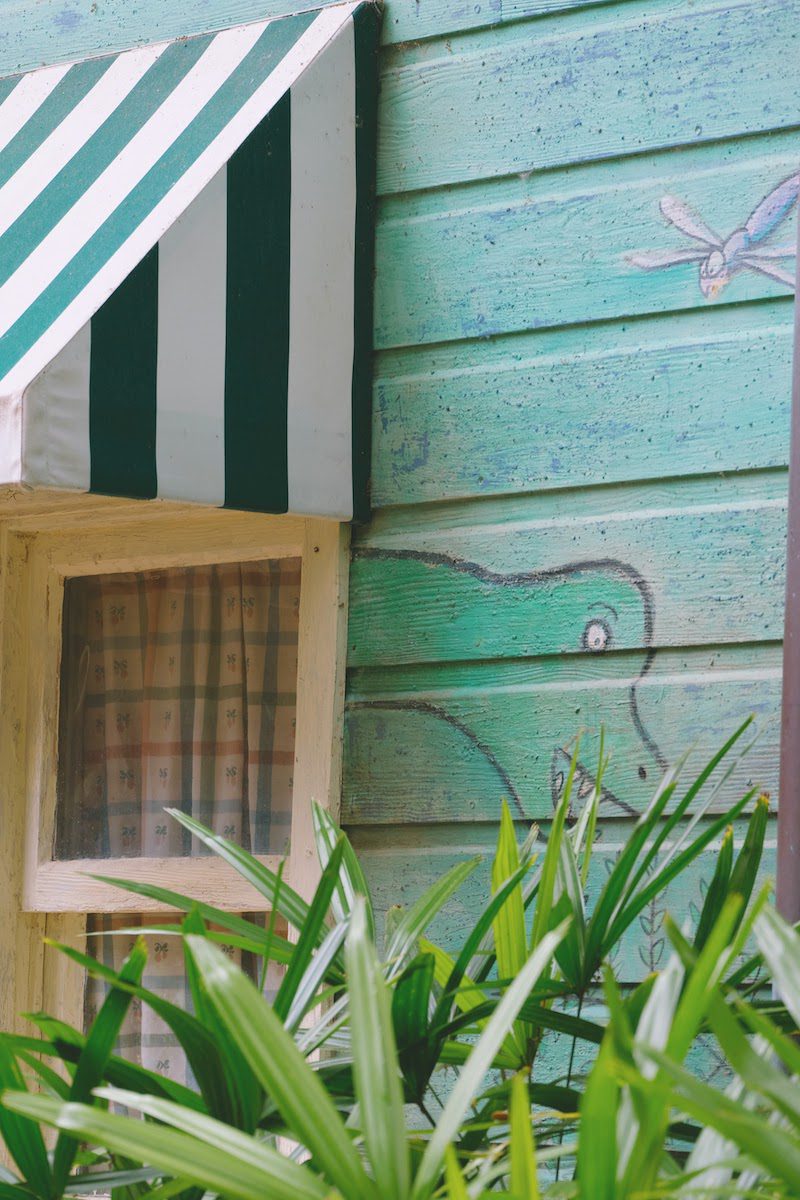

This is a trope familiar to Walt Disney Imagineering. The theme park designers often frame an attraction’s setting as somewhere that “used to be” something else, even though the previous “use” only exists within the attraction’s own fictional lore. Dinosaur Treasures was never a real gas station in Orlando, but it did exist as a gas station in the fantasy of Diggs County, and therefore requires visuals to support that transformation. Another example of this approach to storytelling is Tiana’s Bayou Adventure at Magic Kingdom, which takes place at Tiana’s Foods, formerly a salt mine that Tiana converted into her small business’ headquarters.

Chester & Hester’s Dinosaur Treasures is filled to the brim with knick-knack props, from road signs to an operating model train. This is at odds with the nearby Dino Institute (the setting of the Dinosaur thrill ride), where the study of dinosaurs is respected rather than satirized. According to author Melody Malmberg, writing about Dinosaur Treasures in an official Disney book, “The Institute wants to buy and raze the place, but Chester and Hester’s unidentified heirs have as good a sense of humor as the originators. They won’t sell.” 4 This also implies that Chester and Hester themselves have perhaps died by the time we, the guest, enter the story.


Malmberg describes the essence of DinoLand, U.S.A. as this: “the conflict between chaos and order, authority and disobedience, youthful, creative minds, vs. stodgy, controlling brains.” 5
The art theory of Chester & Hester’s Dino-Rama! at Animal Kingdom
Chester & Hester’s Dino-Rama opened in 2001, expanding the story of Chester & Hester’s Dinosaur Treasures into a more fully realized area with rides and games. In doing so, Imagineers employed an anomaly in the realm of theme park theory: a space that acts as a sequel to the version of itself that preceded its current iteration. The additions of TriceraTop Spin (in 2001) and Primeval Whirl (in 2002) were not just new rides at a Disney theme park, but in-universe new attractions built next door to Chester and Hester’s gas-station-turned-gift-shop.


Within Dino-Rama! in particular, what at first glance appears to be a neglected theme park area in disarray is, in fact, intentionally designed to appear that way. For example, what seems to be old, cracked asphalt in serious need of attention was painstakingly crafted to look that way by sandblasting concrete and chicken wire. 6
Whether the net result of these efforts is positive or negative — or perceived by the common guest in the first place — is subjective. Regardless, there is more to Dino-Rama than meets the eye.


Alex Wright, author and Imagineer, posits that Dino-Rama is “a nostalgic reflection of our appreciation for the intentions of such places, not a cynical view of their creators’ somewhat less sophisticated skills as show people.” Wright goes on to say, “This is a heartfelt place, sincere in its intentions, if not necessarily skilled in its presentations.” 7
When Animal Kingdom opened in 1998, the space that Dino-Rama would eventually occupy was home to Dino Jubilee, an exhibit of real dinosaur fossils inside an air-conditioned tent.
Custom-built sculpture by Mr. Imagination
Disney commissioned artist Gregory Warmack, aka Mr. Imagination, to create a specialty dinosaur sculpture just for DinoLand, U.S.A. The dino, which stands proudly outside of Dinosaur Treasures, was made from recycled materials. 8


The installation came about as a result of Warmack’s involvement with House of Blues opening at Downtown Disney (now Disney Springs) during the development of Animal Kingdom. Joe Rohde, executive designer of Animal Kingdom, wrote in 2020 of the sculpture’s connection to DinoLand, saying, “I think it’s kind of interesting that our tribute to the unsung folk arts of America includes an actual work of unsung folk art.”
Animal Kingdom’s Dino-Rama rides

TriceraTop Spin
TriceraTop Spin is a hub-and-spoke flying attraction in the style of Magic Kingdom’s Dumbo the Flying Elephant and The Magic Carpets of Aladdin — and, in fact, opened the very same year as the latter.


When the wind blows just right, the boisterous tones of TriceraTop Spin’s banjo music (anything but subtle) are the first audio soundbites guests hear from the parking lot as they arrive to Animal Kingdom. On the topic of music, the background loop of Dino-Rama is comprised of family-friendly radio hits such as “All Star” by Smash Mouth and “Shake It Off” by Taylor Swift — again, a stark departure from Disney tradition, by design.
Primeval Whirl
Primeval Whirl combined spinning teacups with a madmouse roller coaster that opened in 2002. Well, two roller coasters, actually; identical tracks stood side by side. The lightly themed storyline of Primeval Whirl was meant to be Chester and Hester’s tongue-in-cheek take on their Dino Institute neighbors sending folks back in time (as seen in the Dinosaur attraction). 9
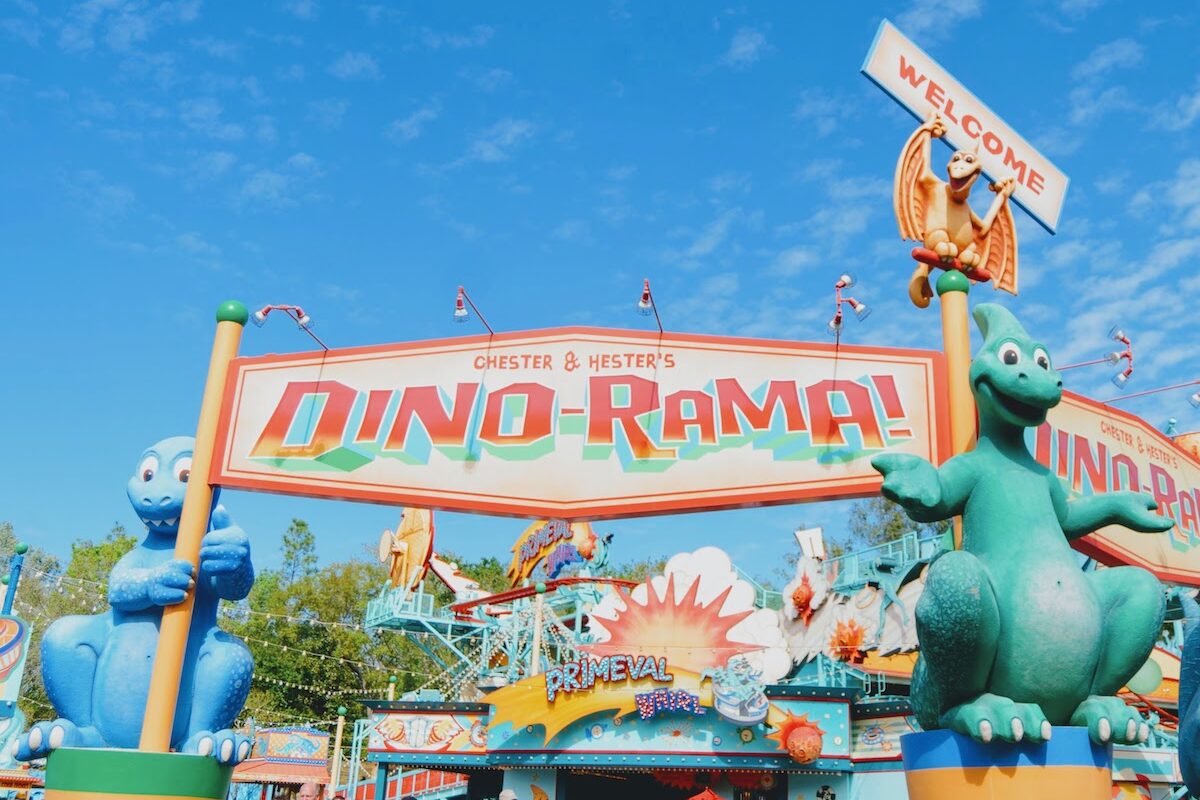
As such, Primeval Whirl was another example of the multilayered lore of DinoLand that likely went unnoticed without its context explained: a ride that tells its story by parodying another ride’s story. Phrased differently, on Dinosaur, your fake time-travel adventure is supposed to be “real” within the narrative. On Primeval Whirl, your fake time-travel adventure was meant to be fake.

This was a departure from the Disney norm. When riding Space Mountain, for example, you know you’re on a roller coaster, but the narrative invites you to forget that the roller coaster track exists — that you’re blasting through space in a rocketship. Primeval Whirl, by contrast, implored the rider to remember that they were riding a roller coaster, that their experience was a tacky brainchild of “local” entrepreneurs.
Following a period of Primeval Whirl only operating seasonally, Disney announced in 2020 that the attraction was closed for good. In the years since, Disney dismantled the coaster and left its former space empty.

Though very different in its execution, the narrative self-awareness of Primeval Whirl almost finds an afterlife in Guardians of the Galaxy: Cosmic Rewind at Epcot. That roller coaster, which opened in 2022, begins its narrative by acknowledging its existence within a theme park; and not just any theme park, but Epcot itself. By the time the ride begins, though, the conceit is gone; we’re “really” in outer space.
The end is near
A detail should be used only if it is essential to the story in some way. There is a big difference between being overwhelmed with detail that really amounts to clutter, and the feeling of perfection that is real storytelling. As designers, we must not make the mistake of thinking that a ‘big look’ with lots of detail is enough. 10
the late john hench, senior vice president of walt disney imagineering
DinoLand has a lot of humor, and because of that I think we can relax some of the seriousness of some of the other themes [of Animal Kingdom] and get away with some hijinx.
Joe Rohde, executive designer of disney’s animal kingdom

More Attractions Magazine stories:
Follow us:
Literature Citations
- “Designing Disney: Imagineering and the Art of the Show” by John Hench with Peggy Van Pelt, page 69 (Disney Editions, 2003).” ↩︎
- “The Imagineering Field Guide to Disney’s Animal Kingdom at Walt Disney World” by Alex Wright, page 119 (Disney Editions, 2007). ↩︎
- “A Portrait of Walt Disney World: 50 Years of the Most Magical Place on Earth” by Kevin M. Kern, Tim O’Day, and Steven Vagnini, page 218 (Disney Editions, 2021). ↩︎
- “The Making of Disney’s Animal Kingdom Theme Park” by Melody Malmberg, page 95 (Hyperion, 1998). ↩︎
- Malmberg, page 34. ↩︎
- Wright, page 115. ↩︎
- Wright, page 114. ↩︎
- Kern, O’Day, and Vagnini, page 219. ↩︎
- Wright, page 116. ↩︎
- Hench with Van Pelt, page 78. ↩︎
j