

Universal awarded four patents in one day for ride systems, adaptive seating and AI technology
Universal City Studios was awarded four U.S. patents on Aug. 11, 2026, covering technologies that range from an unusual ride vehicle capable of transitioning between supported travel and floating operation to a seat designed to conform to individual riders.
The four patents also include a loading system that could provide extra boarding time to an individual ride vehicle without stopping the rest of the attraction and an audio-guide system that uses an AI model to generate information about landmarks.
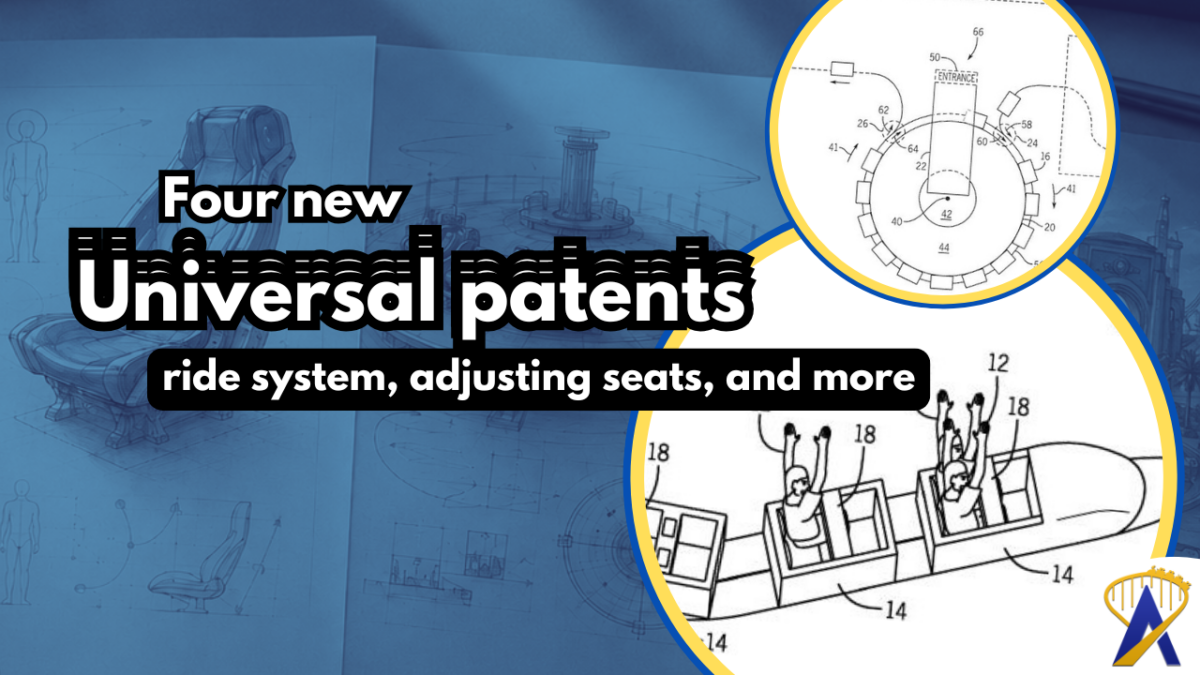
Some of the underlying patent applications have been publicly available for years, so Tuesday’s grants do not represent four newly revealed inventions. They do, however, offer another look at the technologies Universal has been developing and protecting.
Two stand out in particular: the suspension-and-floating ride system and the adjustable ride vehicle seat. In this article, each patent is explained in simple terms before diving into more details.
Four new awarded patents
Patent 1: Ride system with vehicle support for suspension and floating operation
- In simple terms: A ride vehicle could travel while supported by a track system, then enter the water and actually float while remaining connected to the ride hardware.
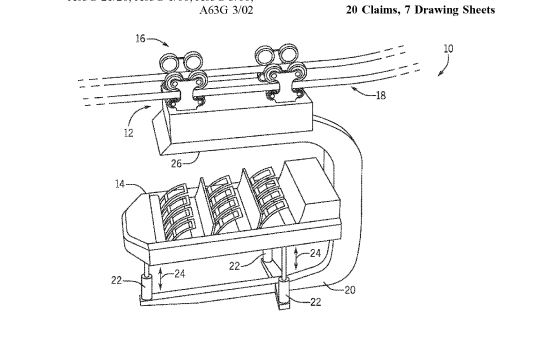
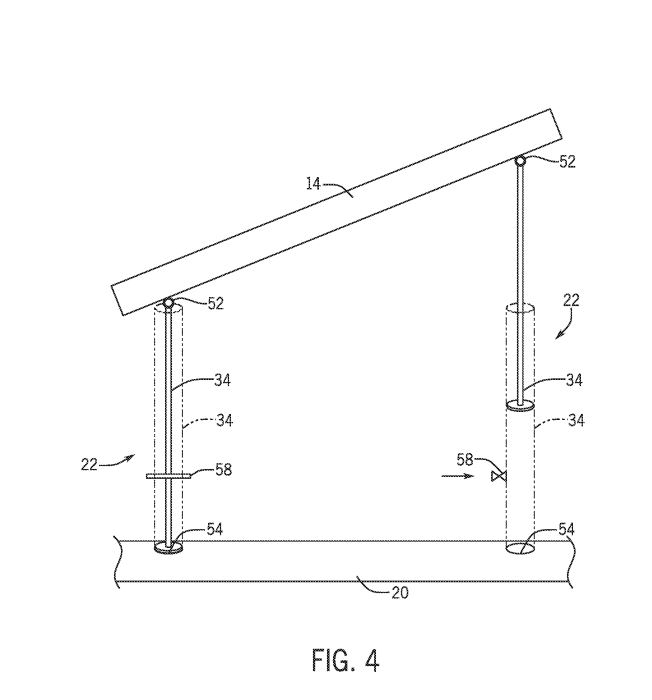
U.S. Patent 12,702,934 describes a buoyant passenger vehicle connected to a track-mounted support, or bogie, through extendable mechanisms.
Those connections can retract when the vehicle needs to be supported more firmly by the ride system and extend when the vehicle enters water. Buoyancy can then lift the passenger vehicle away from its underlying support, allowing it to move more naturally while still remaining connected to the track system.
Universal’s patent describes both an aquatic portion and an aerial portion of a ride path, opening the possibility for a vehicle to transition between distinctly different ride experiences.
From pubs.uspto.gov
The basic guest experience has some parallels with existing technology. Mack Rides’ Rocking Boat, for example, allows a guided passenger boat to float and respond naturally to movement in the water.
Universal’s patent describes its own mechanical approach, using extendable connections between the buoyant vehicle and its track-mounted support. The underlying Universal invention dates to a provisional application filed May 5, 2020, and the U.S. application was published in 2021.
From pubs.uspto.gov
It is also not Universal’s only effort to rethink how theme park vehicles interact with water. Other Universal patents have explored systems in which vehicles can move through aquatic environments using different forms of guidance and propulsion.
Attractions Magazine will take a closer look at this patent separately, including how it compares with Mack’s Rocking Boat technology and other Universal water-ride concepts.
Patent 2: Systems and methods for adjusting a seat pan for a ride vehicle seat
- In simple terms: A ride seat could mold itself around a passenger, then become firmer once the rider is seated.
U.S. Patent 12,703,284 describes a ride vehicle seat containing a flexible membrane filled with what Universal calls an “active fluid.”
The properties of that material can change when exposed to an electrical or magnetic field. In one described operation, the seat remains deformable as the passenger sits down, allowing the seat pan to conform to the rider’s body. The material can then become more rigid and maintain that shape.
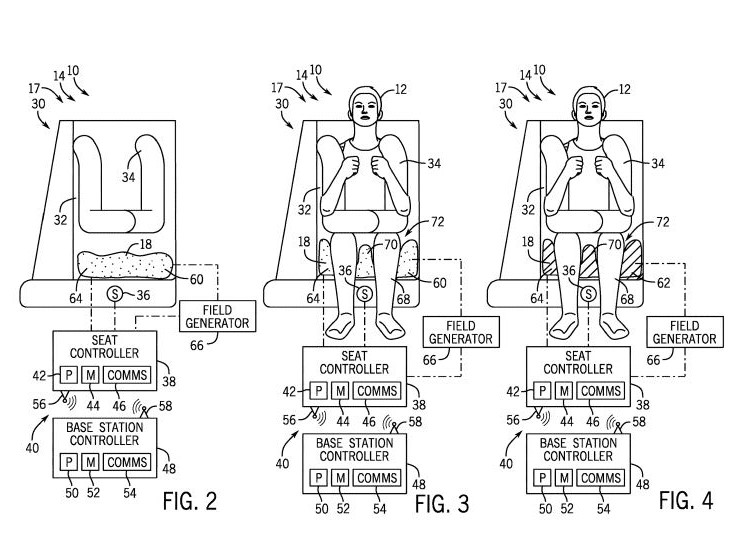
From pubs.uspto.gov
Universal discusses electrorheological and magnetorheological fluids as possible materials for the system.
The patent describes the technology in the context of accommodating passengers with different sizes, shapes and other physical characteristics. That does not necessarily mean the system would replace a traditional restraint; the patent is specifically focused on the seat pan and how it supports the rider.
The underlying smart-material technology already exists in other industries. What is notable here is Universal’s proposed application of it to an amusement ride vehicle.
The application was filed Dec. 19, 2023, and published in June 2025.
Attractions Magazine examines this system in a separate report.
Patent 3: Loading turntable systems and methods
- In simple terms: A ride vehicle that could circle through the loading area again when passengers need more time to board, while other vehicles continue onto the attraction.
U.S. Patent 12,703,409 describes a loading system involving ride vehicles traveling around a rotating turntable.
Track switches can direct individual vehicles either toward the main attraction or through another section of the loading path. That could allow a particular vehicle to remain in the boarding process for additional time without requiring the entire ride system to stop. Think of how many times you’ve been on an omnimover style ride that has slowed down or even stopped while you’re in the middle of the experience—problem solved!
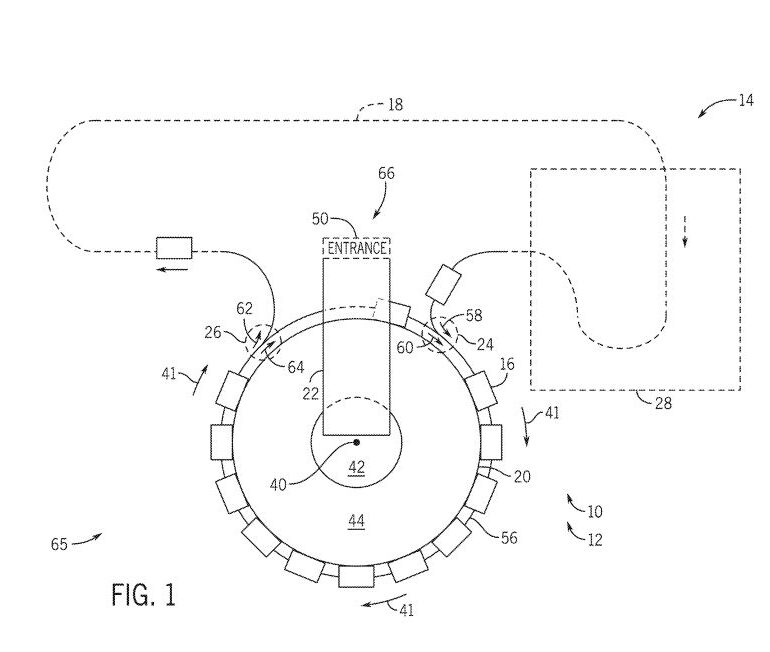
From pubs.uspto.gov
Continuously moving loading platforms are already well established in attractions, but Universal’s patent addresses a more specific operational problem: how to provide additional boarding time to one vehicle while maintaining the movement of others.
The concept comes from an older Universal patent family tracing back to a provisional application filed in 2019, and related versions of the loading system have previously received U.S. patents.
Patent 4: System for an audio guide
- In simple terms: The system could identify what a guest is looking at, ask a large language model to generate a description of that specific landmark, then automatically turn the response into an audio guide — instead of relying only on a library of prewritten, prerecorded tour narration.
U.S. Patent 12,705,994 describes using a camera-equipped device to capture an image and identify a landmark by comparing it with reference imagery.
After identifying the subject, the system can send a request to a large language model, or LLM, receive information associated with the landmark and provide that information to the user as audio.
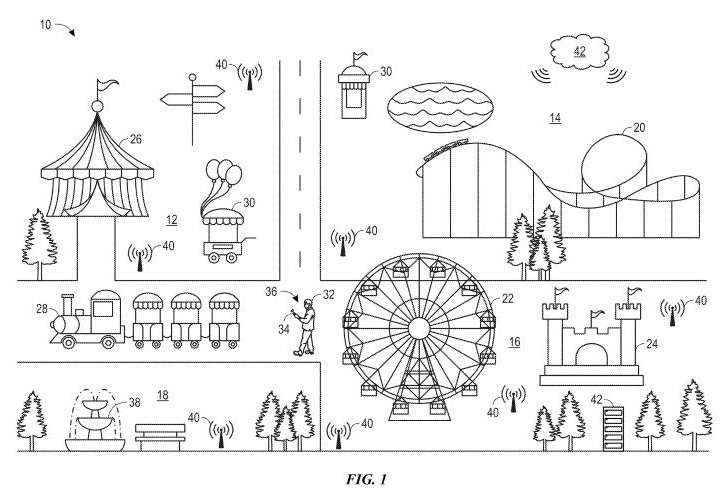
From pubs.uspto.gov
The individual technologies involved — image recognition, generative AI and synthesized speech — already exist. Universal’s patent focuses on combining them into an automated audio-guide system that could be used in an entertainment or destination environment.
The patent does not identify a particular AI provider, theme park or attraction where Universal intends to use the system.
What Universal’s four patents could tell us
A patent grant is not the same as an attraction announcement. Universal routinely protects concepts that may change considerably before reaching guests — or may never appear in a park at all. None of the four patents identifies a future attraction, intellectual property or Universal destination where the technology will be installed.
Still, it can be fun to see the creative minds and problem-solving ingenuity at work.
More Attractions Magazine stories
Follow us:
Ready for adventure? Our trusted partner Universal Fan Travel will handle the planning so you can focus on the fun. They offer free vacation-planning services and have nearly 20 years of experience creating epic vacations. Visit Universal Fan Travel for a fee-free, no-obligation quote today.