



Attractions Expert Q&A: Theron Skees provided creative direction for Hong Kong Disneyland, Disneyland Paris, Hollywood Studios, Castaway Cay
Theron Skees worked for 23 years with Walt Disney Imagineering, beginning as a Field Art Director and most recently as VP Portfolio Creative Executive, providing creative direction for Hong Kong Disneyland, Disneyland Paris, and Disney Hollywood Studios theme parks and contributing creative oversight for Disney Cruise Line ships and Castaway Cay.

In 2020, Theron Skees founded his own company, The Designer’s Creative Studio, which provides innovative, solution-oriented design to grow brand equity and emotionally connect consumers to experiences in the financial, hospitality, healthcare, retail, and themed entertainment industries.
What theme park souvenir might we be surprised to find on your shelf, and what’s its story?
As a former Imagineer, most of the souvenirs I have come from derivatives of projects – and you might see very interesting tidbits from various projects I’ve worked on throughout my career.
The purchased souvenirs are theme park paraphernalia from Japan. They’ve got some of the best products at Tokyo Disneyland, like little model buses, which are really nice. I also have a souvenir from Japan of Mushu, the Chinese dragon from Mulan. The box has Mushu printed cardboard with the ears, nose, and everything; when you open it up, there’s candy inside. Those things are really cool.
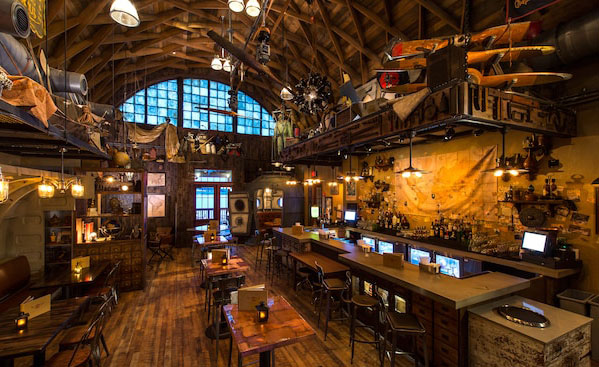
But the collectibles that are most dear to me are items from different projects I’ve worked on, including the original menu design for Jock Lindsey’s Hangar Bar at Disney Springs. They don’t have it anymore, but I have the actual original one we created as a team. I also have the logo of Jock Lindsey’s Hangar Bar, which went on the back of the cast members’ leather jackets, which they don’t wear anymore. So, I have those kinds of fun collectibles. It’s really great when you design something in two dimensions with a team, and then it’s actually produced, and you can see it and hold it. That’s incredibly rewarding.
What theme park have you always wanted to visit but have never been to?
Shanghai Disneyland. I’ve seen many videos and had many colleagues and friends who worked there share incredible stories, but I have not been yet.
I lived in Hong Kong for four years and spent a lot of time in China. It was year three that Hong Kong was open, and my role was to establish the Imagineering team at Hong Kong Disneyland and establish the process for working with the operating teams and maintaining that property. So, we did quite a lot of work. A very large expansion was done while I was there – Toy Story Land, Grizzly Gulch, and Mystic Point were all built during that time – and my team worked very closely with them on that. In fact, we assisted the original Shanghai team with many of their early works, like finding fabrication shops, consultants, and contractors throughout Southeast Asia. But I have never seen the final product, so that’s definitely on my bucket list.

While I was in Hong Kong, I launched a program with Walt Disney Imagineering called Imaginations, which was already in the U.S. It’s been around for well over 30 years and provides university students with the opportunity to form teams, work together on a project, and create a brief that Imagineering would put out. For example, one year the project was “What would a theme park be like if it was designed on the moon?” These teams come together; they’re cross-functional and have many different players. Plus, they have to be co-ed. The winning team gets a one-year paid internship with Walt Disney Imagineering. Students would build models or come in costumes. Sometimes, they’d play music or perform, or they’d have digital fly-throughs of their project. Really great stuff.
I took that program to Hong Kong as a way to get the city culture of Hong Kong more engaged in the idea of the arts and design. Because in Hong Kong, when I was there, you weren’t considered very successful if you were in the arts. It’s not that way now, but then, you had to be in banking or business and needed an MBA.
With the Hong Kong Disneyland team, I reached out to the universities and really leaned into scholarship programs and grants. We launched Imaginations Asia, which was a design competition. The winning team went to California and was able to live and work there for a year as interns at Imagineering. What was great is that Shanghai Disneyland adopted that program and used it there to grow the specialized talent they would eventually need to work within that park system. So, it was really rewarding to do that.
Was there a theme park or attraction that made you want to be in this industry? How did it inspire you?
I grew up in Orlando, and my family was from pretty modest means. Every Christmas, my mother and stepfather gave us the choice to have presents under the tree or take a trip to Disney World for a day. We always took the day at Disney – who wouldn’t do that?
Bless my mom and stepfather because they spent the whole day – all the way to closing – with the four boys in our family. We were running around at light speed and daring to go to Endor and all those places. It’s hard to pick just one that inspired me, but the idea of being immersed in stories of other worlds was highly influential for me.

The part of the story that brings it all together was that I was ten years old when “Star Wars” was released in 1977, and George Lucas brought that incredible film to life. I can’t remember how many times I saw it, but it was a seminal moment because I said I don’t know what that is, but that’s what I want to do.
What I didn’t realize at the time was that I wanted to create those worlds. I wanted to escape into those worlds. So, this love of theme parks, this love of the movies, and Star Wars – those things eventually merged, and I started in film but then transitioned into theme parks, and I’ve been there ever since.
What was your favorite ride or attraction as a child, and why?
That’s a toss-up between Autopia and Space Mountain, but I’m going to say Space Mountain. I loved Autopia, but as a child, Space Mountain edged it out.

It was the idea that you weren’t just in a dark space; you were in outer space. As a young child, I never thought of it as a roller coaster in a dark room; I always thought of it as a journey into outer space. I remember hunching down in the seat because I didn’t know what was out there – it was amazing!
Was there a ride, attraction, or character that frightened you as a child?
I don’t think so. To be honest, I was pretty fearless as a child.
Later in my career, I worked at Disney MGM studios [now Disney’s Hollywood Studios] and had the opportunity to reprofile the Tower of Terror. As a part of that project, I rode it with the ride designer to choose the best movement. The designer said there were 42 different ways that the Tower of Terror could move. Some were subtle; some were really big, like it went up instead of down. We started in the ride shaft, and we rode one and then stopped and made notes, then rode another, stopped and made notes, and did that 42 times. We were a little dizzy when we got off, but it was great.

What was the oddest or coolest job you’ve had in your career?
I think the way I started in themed entertainment might be considered odd but also really cool, and that is I started in a division called artificial rock work, and my role was quite literally to sculpt and art direct these large artificial rocks that guests see all over the Disney parks – and my very first job doing that happened to be my first job with the Disney company.
I worked for Imagineering in a little park in France called Euro Disneyland, which eventually became Disneyland Paris Resort, and the first attraction I ever worked on was Pirates of the Caribbean.

Photo by Samantha Davis-Friedman
I did all of the artificial rock work inside and outside of the attraction, and I was known as a field art director, which was somebody who had the mindset, spatial thinking, artistic vision, and craft. Because most of the individuals on the contractors’ teams who showed up to do that work had never carved rock before. They may have been good with plaster, but I had to teach them and show them the craft of artistically sculpting cement. So that’s probably odd but cool.
When it launched, that attraction was one of the most amazing because it had dueling pirate animatronics – it was the first in the world where two robotic figures actually dueled. It was a silhouette effect where two pirates’ figures were behind a sail. So, you saw that it was a shadow game, but it was two figures that were literally sword fighting, and what was amazing was being an Imagineer behind the scenes and seeing them practice it in a warehouse. In the very first run-through, they actually sliced themselves all up with the swords, so they needed to be adjusted. That was an incredible Pirates of the Caribbean.
What ride or attraction do you think everyone needs to experience and why?
I would have to say Rise of the Resistance simply because it is unlike any other attraction in that there are multiple types of ride components to it, and because of that, it feels less like a ride. When you first walk across to load into the ship, that ship takes you to a larger ship, and then you get into another type of vehicle that travels horizontally and vertically. And all those elements make it feel less like a ride and more like you’re experiencing the world of Star Wars.

It definitely has some first-in-the-world type of components. At the time they were working on that, my assignment was to lead the teams on the three new ships for the Disney Cruise Line. So, although we crossed paths with Scott Trowbridge and his team, I didn’t have insight into what they were doing.
Fast forward years ahead, it’s open, and I finally experienced the attraction. One special effect blew my mind, and that was when Kylo Ren’s lightsaber came down through the doorway. You’re looking up, and there’s a hatch, and the lightsaber comes through and starts cutting. And my mind was popped on how they did that. Really cool.
That’s what we live for. The most challenging job for anyone in narrative experience design is generating a genuine feeling of awe from an audience because we live in a world where people are very well-educated and well-informed. When people are well-informed about something, they tend to be a bit jaded. It’s very difficult to create genuine awe, especially in somebody who builds these things, so major kudos to that team for being able to pull that off.
If you were tasked with creating a new theme park food, what would it be?
Let’s say poutine. If you ever go to Canada, you can get French fries with all kinds of toppings called poutine. So, it’s French fries, which are amazing because they’re cooked in beef tallow, and then they put different toppings and sauce or gravy on them. So, I’ll say poutine for theme parks and top them with pulled pork with barbecue sauce.
You’re a walk-around character for a day; who do you choose?
I probably would be Goofy. I really love humor, and I love being extremely playful. What I like about Goofy is that he has a level of innocence, so he’s not jaded and angry. Donald’s always angry. And in a sense, Goofy has that sort of childlike wonder and doesn’t feel harsh about people.

Goofy also brings levity and laughter in unexpected ways. He’s just going about his business, trying to fish or lift weights or play sports, and ultimately – although he’s well-meaning – he just flubs stuff, and you can’t fault him for it. I think I would like to be Goofy.
What types of attractions would you like to see more of and why?
I have been quite vocal about this. I’m very passionate about combining the digital worlds of gaming. The interactive gaming world has grown exponentially in immersivity, more than just zombies charging you and you’re shooting at them, with much more experiential storytelling.
I would love to see that world converge with the destination, the location-based entertainment world, where all of the science, art, and technology of theme parks are combined with all of the science and technology of the gaming world, and those things are mashed together. That doesn’t mean you ride with a VR brick strapped to your face. When you have an interactive moment in an immersive world, you don’t have to ride through it. There might be moments of ride; there might be moments of interactivity.
There could be very intimate moments with a small group of people and very large moments, like when you’re on a ride system with multiple people. That’s what I would love to see and explore: stories that give attractions a much broader scope to play with, rather than just a small advancement in a ride technology or a new IP that you can put a ride technology in.
The guests would have a lot of agency. I’ve actually had the opportunity to work on this through my own company in Saudi Arabia, and it’s the closest I’ve been to seeing that vision and dream come to life. But it’s less thousands of people an hour through an attraction. It’s more pulsing groups of people through an interactive world where it reacts to guests’ decisions.
There’s an interactivity with the environment itself – they call that Player Versus Environment (PVE) or Player Versus Player (PVP). You would also have non-player characters like you do in the gaming world, but people would be in costume, people would be interacting, and the system itself would track each individual person as they moved through the experience. It would create opportunities in front of them that would change as they played the game as if they’d unfolded the experience themselves.
I would rather create a world where you interact in real-time and things develop based on your decisions and actions, which leverages the best of both the world of gaming and the world of theme parks. That would be my dream – being able to do that. It would be amazing.
Was there any challenge or surprise in your career?
When I transitioned out of film into themed entertainment, every single role I had in theme park work was something I had never done before.
When I was hired at Walt Disney Imagineering, my only experience was working at Universal Studios doing artificial rock work. I had only done that for eight months or so as a consultant. Then, I was hired as the Art Director for the Disney MGM Studios. I had never been an Art Director before and was never responsible for an entire park, with millions and millions of dollars, partnering with an operations team, a maintenance team, and live entertainment. I was fairly new to WDI and was in my late twenties, or maybe 30. That was the very first time I had such a big responsibility, and then every role I had after that was brand new, the first time.
I look back at that, and it was a blessing to have had in my career. I mentor students and other professionals and talk about this. I performed the best when I found myself 50% excited out of my mind to do something, and 50% terrified about doing it because I’d never done it before. Looking back, I think that combination challenged me to focus and really absorb everything I could so I could adapt my skills, lead my team in the appropriate way, and come up with the outcomes that were needed. I never felt bored; I always felt sharp and focused – and if I didn’t know something, I would have to go learn it.
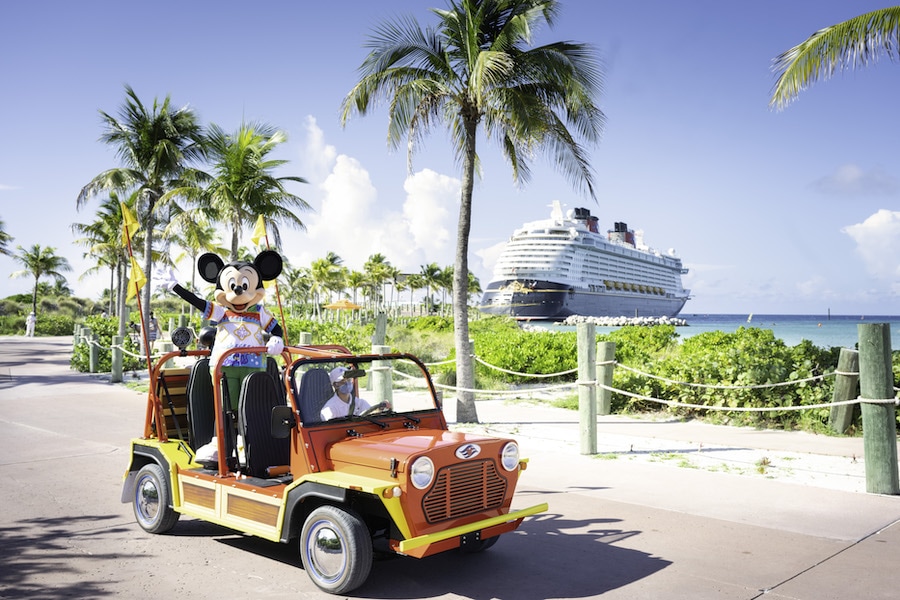
I continue thinking that way today in my own practice, but there were moments in my career when I was terrified and excited. Like when I got promoted to VP and reported to the President, along with only 10 or 11 other people in the whole company. Or when I was put in charge of the Disney Cruise Line’s $5 billion portfolio. I had never done nautical or cruise ship design in my life, so taking that on was amazing.
It’s a principle nobody really talks about. I label it as “learn, adapt, and implement” because as you’re implementing, as you’re leading, and as you’re building, if there’s something that suddenly you don’t know, you’ve got to level up to be able to accomplish the next step, so you have to learn some new things – and in the process of learning, you have to adapt. That’s why we prototype. We try, we take risks, we fail early, we fail fast, but then we move forward, and that’s the implementation phase. So, learn, adapt, and implement. I find that we’re doing that in our personal lives as well as our professional lives all the time. I think that’s what’s exciting. If you’re on a boring project, you’re never challenged with any risk, and that’s not the world for me.
I’ve always tried to lead my teams this way, with a fail-fast mentality – let’s get in and provide team members with an acceptable range of risk-taking. That way, we can get the most innovation and out-of-the-box thinking possible. Some of those won’t work, some might cost too much, and some might take too long, but ultimately, we’re going to discover some real gems that we never would have discovered if we played it safe.
So, that’s my philosophy: to jump in, fail fast, experiment, give agency to my team members, give them a realm of taking risks and failing, and let them know it’s okay to fail. That’s how you get the best – if you don’t fail, you’re not trying hard enough.
Can you talk about what you are working on these days?
In 2020, Covid caused my career at Imagineering to take a left turn, and I started my own company called the Designer’s Creative Studio. I have to admit, as treacherous as the pandemic was for everybody around the world, there was definitely a silver lining for me because it was the best move in my whole professional career to go out on my own. What I do now is offer a range of services as a consultant to companies all over the world. I focus specifically on early-stage engagement, and what’s amazing about that is you can get in at a time when the ideas are just forming.
I like to assist in creative strategy building, thinking about brand and storytelling very early, and then creating the pipeline to accomplish all those things. Once we’ve mapped it out, we’ve built a strategy. We understand the brand, and we understand what the business objectives are. That’s when you create a story that encapsulates the market, the brand, the people, and the business objectives. My “secret sauce” is developing a story that delivers on what I call narrative experience design that can apply to location-based-entertainment, hotels, online shopping, retail, dining, and even pharmaceutical companies.
Just the other day, I helped a leadership team with U.S. Bank, and we worked together with over 200 members of their design staff nationwide. The idea was the power of storytelling in business and how it can be modified. I also worked with a pharmaceutical company, Daiichi Sangko, in Tokyo and taught them storytelling for their frontline brand ambassadors. Also, Allegro, an online shopping website in Poland. So, I’ve done a wide range of stuff and tons of work, including three years in Saudi Arabia, where they’re literally building cities with airports and attractions. It’s been really fun to use the experience I gained in the themed entertainment industry, and packaging it in such a way that it applies across almost every global segment of the economy.
One thing that’s important to understand is that different brands that really connect with us emotionally through an experience could be anything. You go out to eat, and you’re in an amazing environment; the person serving you the food is fantastic, and the meal itself is incredible. Everything about the event, from stem to stern, is just this transformational experience. Well, that’s a brand. That’s a company that has actively designed and created that experience from every stage of the journey. It is more than just designing and creating it the first time; it continues to invest in it operationally throughout its life. That’s a product and a service that has to make its way to other businesses.

So, in business-to-business (B2B) or business-to-consumer (B2C) relationships, everyone wants to work with authentic businesses that build strong relationships and empower them, and that’s somebody they can trust – and customers want the same thing. So that’s the brilliance of story: it communicates brand in an emotionally engaging experience with humans. And it turns out something I learned and pioneered in the theme park industry is quite effective in every industry because we’re dealing with humans. It doesn’t matter if it’s a service, if it’s a product, or if it’s a place. It doesn’t matter what the brand is. There’s always a way to connect more deeply with the customer. I always say my specialty is changing customers into audience members because you can’t really have fans as customers, but Apple has an audience because people sleep outside for four hours to get an electronic device. That’s an emotional relationship with a consumer electronics company.
The largest demographic for purchasing is millennials, and research shows millennials would much rather pay money for an experience than a product.
They think: I don’t want to buy shoes. If I need shoes and I have to buy shoes, then I want to buy shoes and have a great experience doing it. I might go to REI, where I can put on the shoes and climb on this rock thing and talk to somebody who’s an expert hiker and can tell me about the laces and the tread. And that experience is more than just being on Amazon, which is convenient, but it’s a transaction. Those shoes, that money, put it in my cart and click, and it shows up. There’s a convenience to that – and there might be a bit of an emotional connection – but not really.
It’s a lot of fun. When I stepped away from the weekly paychecks that the Disney company offered for almost 30 years, I told my wife that I was not going to work with jerks. I don’t care how well-funded they are or how much they’re going to pay me. I want to partner with people who are pleasureful to work with and who are excited about new things. And I have stuck to my guns and had to turn down some jobs.
You are going to your favorite theme park; which industry people (dead or alive) are you taking with you?
There’s actually an army of people. I would absolutely go with former Imagineer John Hench. Amazing, amazing creative leader, so I would definitely take John. Marty Sklar from Imagineering – I would 100% take him. I think it would be interesting to go with somebody like Elon Musk. I respect how his mind works and how he thinks out of the box. Walking side by side with him would be interesting because he has a business mind and an engineering mind, but he likes to think about impossible things. It’d be interesting to get his take.


Three is probably enough, but I have one more: Chris Nolan, the film director. I love his films, like “Inception,” and how he sees film. He tells a story from a really interesting perspective. He often catches us as moviegoers when we think we’re watching a story unfold from a specific perspective, and then he gives us this “a-ha” moment toward the end of the second act as we’re transitioning into the third act where we realize we’re actually seeing the whole story from another perspective that we didn’t realize. So, I would love to walk through a theme park with Christopher Nolan and talk to him about story perspective and spatial design. I think that would be fascinating.
I would like to leave with the message that if you’re out there, you’re retired, or semi-retired, and you have done this for a while, really think about giving back and helping the community of the next generation to grow. The next generation are the ones who will blow the doors off the ways that we tell stories and invent new ways for narrative experience design.
Writer Kendall Wolf is a long-time consultant in the themed entertainment industry. She has worked with designers, producers, and fabricators to help developers create unique and successful projects around the world. In 2017, she introduced Merlin Entertainments to a development group in Sichuan province for the first Legoland park in China. Kendall continues to consult for the developer to open more themed resorts in China.
Follow us:
More Attractions Magazine stories:
No matter where you want to go, our trusted partner MEI-Travel will handle the planning so you can focus on the memories. They offer free vacation-planning services and have nearly 20 years of experience creating memorable vacations. Visit MEI-Travel for a fee-free, no-obligation quote today.
Very interesting. Thank you.